
During Hasina's visit, which is her first after Modi assumed office in 2014, the two sides will be signing at least 25 pacts in various key sectors including civil nuclear cooperation and defence, but any agreement on the Teesta water sharing is unlikely to be inked.

External Affairs Minister S M Krishna is expected to travel to Kolkata to meet West Bengal Chief Minister Mamata Banerjee and other leaders of ruling Trinamool Congress to discuss the proposed Teesta water-sharing accord with Bangladesh.

India and Bangladesh on Tuesday signed an interim water sharing agreement for Kushiyara river, the first such pact since the signing of the Ganga water treaty in 1996.
India has exempted Bangladeshi exports to Nepal and Bhutan as such trade facilitation is mandatory for landlocked countries under the framework of provisions of the World Trade Organisation (WTO).

Union Home Minister Rajnath Singh on Tuesday said India and Bangladesh would soon approve the Teesta water sharing agreement.

The two sides inked nearly two dozen pacts in key areas of defence and civil nuclear cooperation after "productive" talks between Modi and Bangladesh Prime Minister Sheikh Hasina in the nation's capital.
Leader of Opposition in the Rajya Sabha Arun Jaitley on Saturday said deferment in sealing the Teesta water-sharing pact with Bangladesh showed the UPA government's foreign policy is influenced by "internal contradictions".
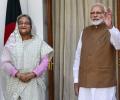
The pacts signed after Modi-Hasina talks provided for deeper cooperation between the two countries in areas of water resources, youth affairs, culture, education and coastal surveillance.

Not many people in Bangladesh are talking about the Teesta issue.
Prime Minister Narendra Modi left behind a "thirsty" and "frustrated" Bangladesh as the two countries could not reach an accord on the Teesta river water sharing issue during his visit to Dhaka, Chinese official media said on Monday.
Sushma Swaraj arrived in Bangladesh capital Dhaka on Wednesday night on her first official visit abroad after becoming External Affairs Minister during which she will hold talks with the top leadership on key bilateral issues including land boundary agreement, proposed Teesta river pact and illegal immigration.
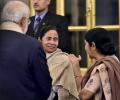
Amid talk of bonhomie between the two, West Bengal Chief Minister Mamata Banerjee has decided to accompany Prime Minister Narendra Modi on his two-day visit to Bangladesh beginning June 6.
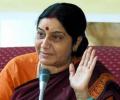
External Affairs Minister Sushma Swaraj on Wednesday held talks with her Bangladeshi counterpart Abul Hassan Mahmood Ali on key bilateral issues, including Land Boundary Agreement and proposed Teesta river water sharing deal, during which the Indian side also raised the matter of illegal immigration.
Bangladesh's main opposition Bangladesh Nationalist Party on Thursday called Prime Minister Manmohan Singh's Dhaka visit largely "a failure" due to "weak diplomacy" of the Hasina government, while the mainstream media said the deferring of the Teesta water-sharing pact dealt a "severe blow" to bilateral ties.

External Affairs Minister Sushma Swaraj on Thursday called on Bangladeshi Prime Minister Sheikh Hasina and discussed key bilateral issues.
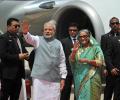
Prime Minister Narendra Modi on Saturday arrived in Dhaka to a red carpet welcome on his maiden visit which is expected to put ties with Bangladesh in a new trajectory, as the two sides will firm up a number of pacts to boost cooperation besides ratifying the long-pending Land Boundary Agreement.
Modi will also push for involvement of Indian companies in setting up of ports in that country.

The HMO said it will amend the rules to increase the time limit of filing of appeals in foreigners tribunals from 60 to 120 days for those who would be excluded from the final NRC.
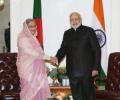
Ahead of his two-day maiden visit to Bangladesh, Prime Minister Narendra Modi on Thursday said he was looking forward to it with a great sense of "enthusiasm and delight" as the two sides readied a host of pacts to be signed including one on enhancing connectivity.

Describing Bangladesh as an 'exceptional neighbour', India on Friday said Modi's 'historic' visit there from Saturday will help the two countries.
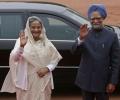
The compulsions of domestic politics notwithstanding, India and Bangladesh script a new story in bilateral relations, say Nayanima Basu and Aditi Phadnis
Prime Minister Narendra Modi has positioned himself as a credible partner for Bangladesh. He has scored by getting West Bengal Chief Minister Mamata Banerjee to travel with him to Dhaka, says Srinath Raghavan

The two governments are slated to ink a slew of agreements.
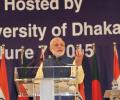
In a blunt attack on Pakistan, Prime Minister Narendra Modi on Sunday accused it of creating "nuisance" and "constantly" troubling India by promoting terrorism.

